PDCCH Order is a mechanism by which eNB force UE to initiate PRACH. This procedure usually happens when Network and UE briefly lost sync while in connected states and user data is available to be sent out on Network side. As you know, one of the most important purpose of RACH is to let UE obtain the synchronization with network and establish the iniitial connection pipe. In most case, the decision to initiate (trigger) PRACH is done by UE side. But there is some case where Network (eNB) need to force UE to initiate the RACH. PDCCH Order is the mechanism. The role of PDCCH Order in normal LTE operation can be illustrated as shown below. (I think the overall description of PDCCH order is much better described in PDCCH Order in LTE at Simpletechpost).
NOTE : Regarding how PDCCH is configured and tested, check out this tutorial of Amarisoft TechAcademy.
A PDCCH order is a DCI format 1A, sent on the PDCCH and addressed to the C-RNTI of the UE, with its fields set to a fixed pattern. The pattern tells the UE to start a random access procedure at once. The preamble index in the order decides whether that procedure is contention free or contention based, and the two sections below show each case.
Followings are the topics to be covered in this page.
- Contention Free RACH triggered by PDCCH Order
- Contention Based RACH triggered by PDCCH Order
- PDCCH Order in 36.321 and 36.213
- DCI Format 1A Contents for PDCCH Order
- Reference
Contention Free RACH triggered by PDCCH Order
Why does the eNB order a random access instead of simply scheduling the downlink data? A UE whose timeAlignmentTimer has expired treats its uplink as not synchronized. It cannot send a HARQ ACK/NACK or a CSI report until it has a new timing advance, so the eNB first has to bring the uplink back into sync.
The sequence below shows the contention free case. The UE is in RRC connected state but out of sync, and downlink data arrives at the eNB. The eNB sends a PDCCH with DCI 1A as a PDCCH order, and the UE answers with a PRACH preamble (msg1).

Contention free RACH triggered by a PDCCH order. The order carries a dedicated preamble, so the procedure ends with the RACH Response, and msg3 is an ordinary PUSCH transmission.
In the contention free case, the order carries a Preamble Index other than 000000. The UE sends that dedicated preamble, and no other UE uses it at the same time. The procedure is complete as soon as the RACH Response (msg2) carries the same preamble identifier, because no contention can occur (36.321 v19.3.0 clause 5.1.4). The RACH Response also carries a timing advance command, so the UE is back in sync after msg2. The PUSCH marked msg3 in the diagram is a normal uplink transmission on the grant from msg2.
Preamble Index other than 000000 : a dedicated preamble, no contention.Procedure complete at msg2 : the RACH Response matches the dedicated preamble.Timing advance in msg2 : the UE is back in sync.
Contention Based RACH triggered by PDCCH Order
The eNB does not always have a dedicated preamble to spare. In that case the order sets the Preamble Index to 000000, and the UE picks a preamble itself, as in a normal contention based RACH. The UE then has to prove its identity in msg3, which adds two steps to the sequence.
The sequence below shows the contention based case. After the RACH Response, the UE sends msg3 on the PUSCH with its C-RNTI. The eNB answers with a PDCCH addressed to that C-RNTI (msg4), and the UE continues with PUSCH data (msg5).
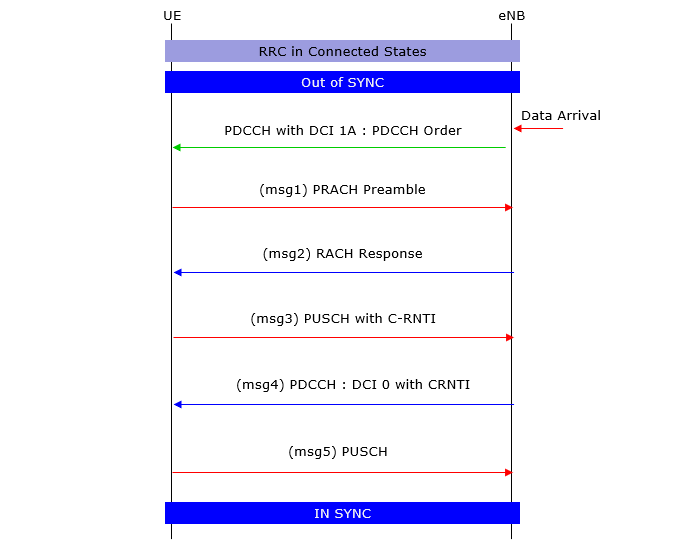
Contention based RACH triggered by a PDCCH order. The UE identifies itself with its C-RNTI in msg3, and the PDCCH addressed to that C-RNTI in msg4 resolves the contention.
Contention resolution is simpler here than at initial access. The UE already has a C-RNTI, so msg3 carries a C-RNTI MAC control element instead of a CCCH message. For a procedure started by a PDCCH order, 36.321 clause 5.1.5 treats any PDCCH addressed to that C-RNTI as successful contention resolution. The diagram uses a DCI 0 uplink grant for msg4, which is one such PDCCH.
Preamble Index 000000 : the UE selects the preamble itself.msg3 carries the C-RNTI : as a MAC control element.msg4 is a PDCCH to the C-RNTI : any such PDCCH resolves the contention.
PDCCH Order in 36.321 and 36.213
Where is the PDCCH order written down in 3GPP? The MAC specification defines when a random access starts, and the physical layer specification defines when the preamble goes out. The quotation below is the first of these.
You would find statement of PDCCH order in 3GPP as shown below.
36.321 - 5.1.1 says
The Random Access procedure is initiated by a PDCCH order, by the MAC sublayer itself or by the RRC sublayer. Random Access procedure on an SCell shall only be initiated by a PDCCH order.
The same clause of 36.321 v19.3.0 adds a condition for the SCell. On an SCell, the PDCCH order must carry a Preamble Index other than 000000, so a random access on an SCell is always contention free. That random access serves only to get a timing advance for a secondary timing advance group, since the SCell has no contention resolution of its own.
The timing comes from 36.213 v19.4.0 clause 6.1.1. If the order arrives in subframe n, the UE sends the preamble in the first subframe n+k2, with k2 at least 6, where a PRACH resource is available. With multiple timing advance groups and a carrier indicator field, the carrier indicator in the order selects the serving cell for the preamble.
36.321 clause 5.1.1 : a PDCCH order is one of three triggers for random access.SCell random access : only by a PDCCH order, always with a dedicated preamble.Preamble at n+k2, k2 at least 6 : 36.213 clause 6.1.1.
DCI Format 1A Contents for PDCCH Order
As you saw in the sequence diagram shown above, PDCCH Order is triggered by DCI 1A. Actually, the physical entity of PDCCH Order is DCI 1A. In other words, PDCCH Order is a special form of DCI 1A with the fields as described below (NOTE : 36.212 - 5.3.3.1.3 says "Format 1A is used for random access procedure initiated by a PDCCH order only if format 1A CRC is scrambled with C-RNTI and all the remaining fields are set as follows:") .
The UE recognizes the order by its fixed values: the resource block assignment is all ones, and all the bits after the PRACH Mask Index are zero. For FDD with 50 RB, the resource block assignment takes ceil(log2(50 x 51/2)) = 11 bits. The table below follows 36.212 v19.3.0 clause 5.3.3.1.3, which also allows a 0 or 3 bit carrier indicator in front of the flag.
|
Field |
Number of Bits |
Value for PDCCH Order |
Flag for format0/format1A differentiation |
1 |
1, for format 1A |
|
Localized/Distributed VRB assignment flag |
1 |
0 |
|
Resource block assignment |
ceil(log2(NRBDL(NRBDL+1)/2)) |
All 1 |
|
Preamble Index |
6 |
To be specified by Network |
|
4 |
To be specified by Network, 36.321 Table 7.3-1 |
|
|
All the remaining bits in format 1A for compact scheduling assignment of one PDSCH codeword |
|
All 0 |
36.213 v19.4.0 Table 8-4 lets the UE find a PDCCH order in both the common and the UE specific search space for its C-RNTI. From Release 11, 36.212 also allows the order to be carried on the EPDCCH, in the UE specific search space only (Table 8-4A).
36.321 - Table 7.3-1: PRACH Mask Index values
The PRACH Mask Index narrows down which PRACH occasions the UE may use for the ordered preamble. Value 0 allows every PRACH resource, values 1 to 10 select one PRACH resource index, and values 11 and 12 select every even or odd PRACH opportunity. In 36.321 v19.3.0 the FDD column also applies to IoT NTN TDD mode, and the values are otherwise unchanged.

36.321 Table 7.3-1. The values 7 to 10 exist only for FDD, and the values 13 to 15 only for TDD, where a subframe can carry more than one PRACH resource.
DCI Format 1A and Format 6-1A in 36.212
The two quotations below show that the order is not limited to format 1A. Format 6-1A is the MPDCCH format for BL/CE UEs, and its order adds a 2 bit Starting CE level to the Preamble Index and the PRACH Mask Index.
36.212 - 5.3.3.1.3 says
DCI format 1A is used for the compact scheduling of one PDSCH codeword in one cell and random access procedure initiated by a PDCCH order
36.212 - 5.3.3.1.12 says
DCI format 6-1A is used for the compact scheduling of one PDSCH codeword in one cell and random access procedure
initiated by a PDCCH order.
In 36.212 v19.3.0 the wording for format 6-1A is longer: the format now also notifies an SC-MCCH change and handles preconfigured uplink resources and direct indication. NB-IoT uses format N1 with a 1 bit NPDCCH order indicator instead.
Format 1A order : flag 1, RB assignment all ones, Preamble Index 6 bits, PRACH Mask Index 4 bits, the rest zero.Format 6-1A order : adds a 2 bit Starting CE level for BL/CE UEs.PRACH Mask Index 0 : any PRACH resource.
Reference
[1] 3GPP TS 36.212 v19.3.0 - clauses 5.3.3.1.3 Format 1A and 5.3.3.1.12 Format 6-1A
[2] 3GPP TS 36.213 v19.4.0 - clause 6.1.1 and Tables 8-4 and 8-4A
[3] 3GPP TS 36.321 v19.3.0 - clauses 5.1.1, 5.1.4 and 5.1.5, and Table 7.3-1